
Introduction
The landscape of creative expression in 2025 has fundamentally shifted. No longer confined to artists and designers working in traditional studios, creative thinking has become a core business competency. Organizations worldwide now recognize that innovation, problem-solving, and competitive advantage hinge on the ability to think creatively and express ideas through visual storytelling, design thinking, and artistic innovation. Whether you’re building a career in the creative industries, developing a creative practice, or integrating creative problem-solving into your professional life, understanding the intersection of creative expression, design thinking, and professional development is essential.
Design thinking represents a paradigm shift—a methodology that places human needs at the center of problem-solving and channels creative expression into practical, innovative solutions. This comprehensive guide explores how design thinking principles, creative expression techniques, and artistic development combine to unlock unprecedented opportunities in the creative economy. Whether you’re an aspiring creative professional, an established artist seeking to expand your impact, or a business leader implementing innovation frameworks, this guide provides the knowledge and strategies to master design thinking and leverage creative expression for measurable success.
The Foundation: Understanding Design Thinking and Creative Expression
What Is Design Thinking and Why It Matters in 2025
Design thinking is fundamentally a philosophy of creative problem-solving that prioritizes human empathy, iterative experimentation, and collaborative ideation. Unlike traditional analytical approaches that focus first on efficiency and profit margins, design thinking starts with the essential question: “What do people actually need?” This human-centered methodology transforms how organizations approach challenges—from product development and service innovation to internal process optimization and artistic expression.
The methodology has transcended its origins in design studios and now permeates corporate innovation departments, educational institutions, and entrepreneurial ventures. According to leading research in creative industries, organizations implementing design thinking processes report significantly improved innovation outcomes, higher customer satisfaction, and enhanced employee engagement. This isn’t theoretical—it’s measurable business impact driven by structured creative thinking.
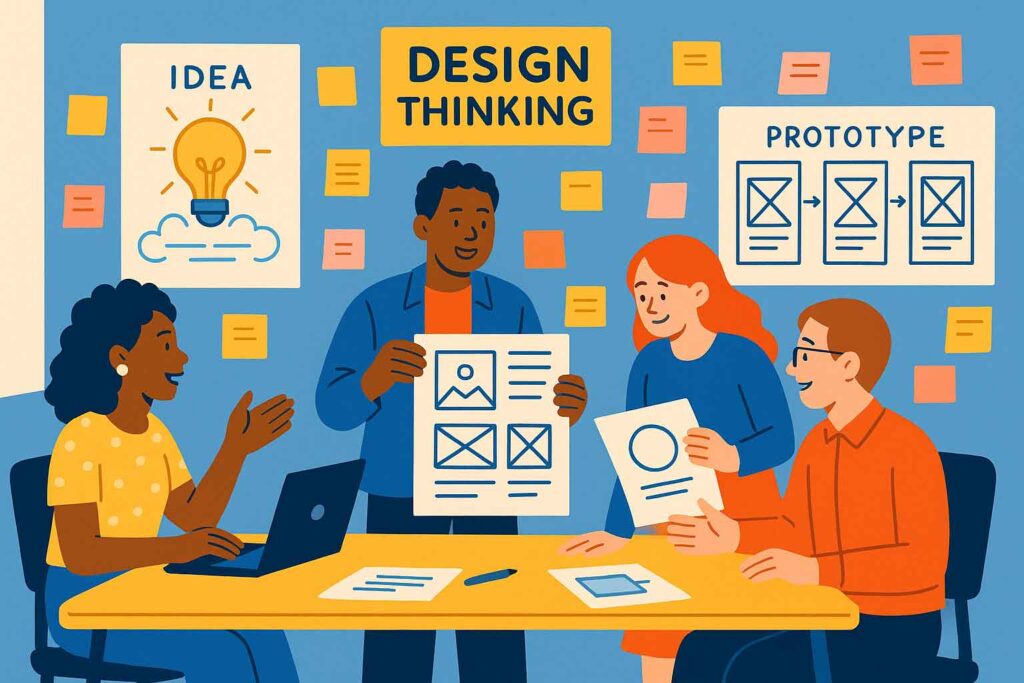
Design thinking comprises five sequential yet iterative phases: Empathize, Define, Ideate, Prototype, and Test. Each phase emphasizes different cognitive modes and creative expression techniques, yet together they form a cohesive framework for transforming creative ideas into viable, desirable solutions. This methodology integrates beautifully with artistic development, enabling professionals to channel their creative energy toward meaningful, user-centered outcomes rather than abstract self-expression alone.
The Psychology of Creative Expression: Why Humans Need Creativity
The drive toward creative expression is neurologically hardwired into human consciousness. Research in neuroscience and cognitive psychology reveals that engagement in creative activities activates reward pathways in the brain, triggering the release of dopamine and promoting a state of “flow”—where concentration deepens, time dissolves, and performance peaks. This isn’t merely pleasurable; it’s fundamental to psychological well-being.
Creative expression serves multiple psychological functions: it facilitates emotional processing, enables self-understanding, supports identity development, and provides pathways for communicating complex internal states that resist verbal articulation. For professionals, this means that integrating creative thinking into work isn’t an indulgence—it’s an investment in cognitive function, emotional resilience, and innovation capacity. Creative practitioners report lower stress levels, improved problem-solving abilities, and enhanced adaptability to change—precisely the competencies most valuable in volatile, uncertain economic landscapes.
The intersection of professional development and creative practice creates synergistic benefits: professionals who engage regularly in creative activities demonstrate superior performance in strategic thinking, cross-functional collaboration, and adaptive decision-making—skills directly transferable to any industry or role.
The Design Thinking Process: A Deep Dive Into Transformative Creative Problem-Solving
Phase 1: Empathize—The Foundation of Human-Centered Creative Solutions
The empathize phase of design thinking demands something counterintuitive in professional contexts: genuine curiosity about other people’s experiences, perspectives, and unmet needs. This phase isn’t about collecting demographic data or conducting superficial surveys; it’s about deep observation, active listening, and imaginative perspective-taking. Creative expression plays a crucial role here—not artistic expression per se, but the creative capacity to imagine how others experience the world.
Effective empathy techniques include:
- In-depth user interviews: Direct conversations with intended users or stakeholders, asking open-ended questions that reveal underlying motivations, frustrations, and aspirations
- Immersive observation: Spending time in the actual environments where problems manifest, observing behaviors and workflows
- Empathy mapping: Developing rich psychological profiles of target users, capturing what they see, think, feel, and do
- Persona development: Creating realistic composite characters representing different user segments, complete with goals, challenges, and decision-making criteria
This phase requires a specific artistic mindset—suspension of judgment, tolerance for ambiguity, and genuine interest in human diversity. The creative professional recognizes that mastering this phase directly correlates with innovation quality; solutions grounded in authentic empathy consistently outperform those based on assumptions.
Phase 2: Define—Translating Empathy Into Problem Clarity
The define phase transforms raw empathic insights into clear, actionable problem statements. This isn’t as straightforward as it sounds. The obvious problem—what users explicitly state they need—often masks deeper underlying challenges that, when addressed, deliver exponentially greater impact.
Creative thinking proves essential during problem definition. The ability to reframe challenges, look for unexpected connections, and challenge conventional assumptions enables teams to move beyond surface-level problem articulation. Effective problem definition techniques include:
- “How Might We” (HMW) questions: Reframing problems as possibility spaces rather than constraints (“How might we reduce patient wait times?” versus “Waits are too long”)
- Root cause analysis: Drilling beneath symptoms to identify systemic causes
- Problem clustering: Grouping related issues to identify fundamental themes
- Reframing workshops: Collaborative sessions where diverse perspectives challenge dominant problem interpretations
A well-defined problem statement should be specific enough to guide solution development yet expansive enough to encourage innovative thinking. It should reflect genuine user needs while remaining actionable within realistic resource constraints. This balance—specificity without constraint—requires both analytical precision and creative flexibility.
Phase 3: Ideate—Generating Diverse Creative Solutions
The ideation phase is where creative expression becomes truly generative. This phase explicitly embraces creative divergence—exploring maximum solution possibilities before converging on the most promising concepts. Effective ideation requires psychological safety, where unconventional ideas receive consideration rather than dismissal.
Proven ideation techniques include:
- Brainstorming sessions: Unstructured or semi-structured group ideation, emphasizing quantity over quality initially
- Crazy Eights: A timed sketching exercise where participants rapidly generate eight distinct concepts in eight minutes
- Mind mapping: Visual brainstorming that captures ideas hierarchically, revealing connections and patterns
- Reverse brainstorming: Asking “How could we make this worse?” to identify previously unconsidered solutions
- Analogical thinking: Drawing inspiration from solutions in completely unrelated domains
- Constraint-based ideation: Deliberately imposing resource or technical limitations to spark creative thinking
During ideation, quantity genuinely drives quality. Research in creative psychology demonstrates that diverse solution generation correlates strongly with breakthrough innovation. The first ideas are typically incremental refinements of existing approaches; transformative solutions often emerge only after exploring dozens of concepts.
Effective ideation balances artistic creativity with practical feasibility consideration. Too much focus on feasibility prematurely constrains creative thinking; too little disconnects ideas from user reality. The sweet spot encourages audacious creativity anchored in authentic user insight.
Phase 4: Prototype—Making Ideas Tangible
The prototyping phase converts abstract concepts into tangible representations—low-fidelity models, sketches, wireframes, role-playing simulations, or functional mockups. Prototyping serves multiple critical functions: it externalizes abstract thinking, enabling team collaboration and refinement; it reveals hidden implementation challenges early; it provides concrete artifacts for user feedback.
Prototyping approaches vary by context:
- Sketches and wireframes: Quick visual representations of user flows, interface layouts, or spatial configurations
- Role-playing and simulation: Acting out user scenarios to identify friction points and opportunities
- Low-fidelity models: Paper prototypes, cardboard mockups, or simple digital mock-ups
- Functional prototypes: Partially functional systems demonstrating key features or workflows
- Storyboards and scenario maps: Sequential visuals depicting user journeys and interactions
A critical principle: prototypes aren’t finished products; they’re learning instruments. The goal isn’t perfection but clarity—communicating enough about the concept to gather meaningful feedback. Many organizations squander prototyping’s potential by overinvesting in fidelity, when low-fidelity approaches often generate richer learning.
Creative expression during prototyping takes specific forms: visual communication clarity, scenario construction that illuminates user experience, and iterative refinement based on emerging insights. The prototyping phase bridges abstract creative thinking and concrete problem-solving.
Phase 5: Test—Rigorous Evaluation and Iterative Refinement
The testing phase evaluates prototypes against user needs and business objectives, identifying what works, what doesn’t, and what requires rethinking. Testing isn’t final judgment; it’s learning that drives iterative refinement. Most initial prototypes reveal implementation challenges or user misunderstandings that necessitate returning to earlier phases.
Testing methodologies include:
- User testing sessions: Direct observation of users interacting with prototypes
- Structured interviews: Post-interaction conversations exploring user reactions and suggestions
- Surveys and questionnaires: Quantitative feedback on specific aspects of the prototype
- A/B testing: Comparing two design variations to identify which performs better
- Diary studies: Tracking user experiences with prototypes over extended periods
Testing reveals not whether an idea is “good” but whether it adequately addresses identified user needs and whether implementation approaches prove viable. Successful testing often generates new questions, necessitating return to the ideation phase for refined solutions.
The iterative nature of design thinking distinguishes it from linear problem-solving approaches. Rather than moving definitively through phases once, design thinking embraces cycles of refinement, with each iteration building on previous learnings. This approach aligns naturally with creative practice—the continuous refinement and experimentation fundamental to all artistic development.
Integrating Creative Expression Into Design Thinking: The Artistic Dimension
Visual Storytelling and Communication: Making Solutions Resonate
Visual storytelling amplifies design thinking’s impact. Throughout design thinking phases, visual communication—whether sketches, diagrams, infographics, or narrative illustrations—transmits complex ideas more efficiently than verbal explanation alone. Creative expression through visual means bridges analytical and intuitive understanding, enabling diverse stakeholders to understand and contribute meaningfully.
Effective visual communication techniques within design thinking include:
- User journey maps: Sequential visualizations depicting how users interact with systems across touchpoints
- Service blueprints: Diagrams revealing both visible user interactions and backstage service operations
- Emotional arc visualizations: Mapping emotional experiences across user journeys, identifying peak frustration and satisfaction moments
- Scenario storyboards: Sequential illustrations depicting potential user interactions with proposed solutions
- Data visualization: Transforming quantitative findings into accessible graphical representations
Artistic skill in visualization—understanding color psychology, composition, visual hierarchy, and narrative sequencing—directly enhances design thinking effectiveness. Teams incorporating professional visual communication specialists typically generate higher-impact solutions and achieve faster stakeholder buy-in.
Color Psychology and Emotional Resonance in Creative Problem-Solving
Color psychology represents a sophisticated tool within creative expression frameworks. Colors carry psychological associations—warm hues evoke energy and optimism, cool tones communicate calm and trust, saturated colors suggest enthusiasm while desaturated palettes imply sophistication. Strategic color deployment within design thinking contexts (prototypes, presentations, visualizations) influences perception and emotional reception.
Understanding color theory enables creative professionals to:
- Enhance comprehension: Using color to organize information hierarchically or distinguish between different system components
- Evoke appropriate emotional responses: Selecting palettes that reinforce intended brand personality or solution positioning
- Improve accessibility: Ensuring sufficient contrast and avoiding color combinations that disadvantage color-blind users
- Guide attention: Strategically deploying accent colors to direct viewer focus toward critical elements
While color psychology isn’t deterministic—cultural factors significantly influence color interpretation—understanding these associations enables more intentional, effective creative expression.
Embracing Ambiguity: The Artist’s Approach to Problem-Solving
Traditional business thinking prioritizes clarity, certainty, and rapid decisiveness. Artistic practice, conversely, embraces ambiguity, experimentation, and tolerance for uncertainty. Paradoxically, this artistic orientation proves essential for breakthrough innovation within design thinking frameworks.
The capacity to remain comfortably within ambiguity—to explore multiple competing solutions simultaneously without premature convergence—directly correlates with creative breakthrough. Artists understand that apparent dead-ends often contain unexpected opportunities; what initially appears contradictory frequently resolves through deeper investigation.
Design thinking increasingly incorporates this artistic mindset:
- Divergent thinking phases that explicitly resist premature convergence
- Prototyping approaches that test radical alternatives alongside incremental improvements
- Iterative refinement that views initial failures as learning rather than judgment
- Collaborative ideation that values diverse, sometimes contradictory perspectives
Organizations successfully implementing design thinking cultivate psychological safety around unconventional thinking, experimentation, and intelligent failure—precisely the conditions within which artistic creativity flourishes.
The Creative Industries Boom: Professional Opportunities in 2025
Market Growth and Economic Significance
The creative industries represent one of the fastest-growing economic sectors globally. In the UK alone, creative industries contributed £124 billion in gross value added to the economy in 2023, supporting 2.4 million jobs. Over the past decade, creative sector output has grown at 1.5 times the rate of broader economic growth, reflecting increasing organizational and consumer investment in creative services, design and branding, and innovative problem-solving.
This growth reflects fundamental economic trends: as developing economies capture commoditized manufacturing, advanced economies compete through innovation, design, brand differentiation, and creative content—all requiring sophisticated creative expression and design thinking capabilities. Organizations recognize that sustainable competitive advantage increasingly derives from creativity rather than efficiency alone.
Key growth drivers in the creative economy include:
- Digital transformation: Organizations across sectors require design and UX expertise for digital product development
- Content proliferation: Exploding demand for visual storytelling across social media, streaming platforms, and branded content
- Experience economy: Growing consumer preference for memorable experiences over passive product consumption
- Sustainability and ethics: Organizations need creative approaches to addressing environmental and social challenges
- AI-augmented creativity: Emerging opportunities integrating AI tools with human creative thinking
Career Pathways and Professional Development Strategies
Contemporary creative careers encompass diverse specializations and working arrangements:
- Design and branding: Visual identity development, UX/UI design, brand strategy
- Content creation: Video production, copywriting, photography, social media content
- Art direction: Visual leadership for campaigns, publications, and digital experiences
- Creative strategy: Positioning and strategic thinking informing creative execution
- Emerging specializations: AR/VR design, AI-augmented creative tools, immersive storytelling
Professional advancement within creative fields increasingly requires:
- Technical skill mastery in relevant tools and platforms
- Business acumen for freelance/independent practitioners
- Continuous learning as tools and trends evolve rapidly
- Portfolio development demonstrating versatility and evolution
- Networking and community engagement for opportunity discovery
- Specialized expertise in specific domains (AI integration, sustainable design, accessibility)
Building a sustainable creative practice requires integrating artistic development with business discipline—creating compelling work while maintaining financial sustainability and market relevance.
AI and Human Creativity: Collaboration Rather Than Replacement
One of 2025’s most significant developments is the emergence of human-AI creative collaboration. Rather than replacing human creators, AI tools are augmenting creative capabilities. Tools like Midjourney, Adobe Firefly, and Claude enable rapid exploration of design variations, automated routine tasks, and conceptual development support.
Creative professionals successfully leveraging AI adopt specific approaches:
- Using AI for ideation acceleration: Rapidly generating visual variations on concepts, then refining promising directions
- Automating routine tasks: Liberating human attention for strategic and conceptual work
- Maintaining human creative control: Treating AI outputs as starting points rather than finished work
- Preserving creative voice: Using AI tools while maintaining distinctive artistic perspective
- Ethical consideration: Ensuring AI integration respects copyright, originality, and sustainable practices
The professionals thriving in 2025’s creative landscape possess both artistic mastery and AI tool fluency—understanding how to leverage machine capabilities while maintaining human judgment, originality, and ethical standards.
Building Your Design Thinking and Creative Expression Practice
Establishing Creative Routines and Professional Discipline
Sustainable creative practice requires consistent engagement, deliberate skill development, and systematic reflection. Successful creative professionals establish routines that balance:
- Focused creative work: Dedicated time for deep engagement without interruption
- Skill development: Continuous learning through formal education, tutorials, experimentation
- Portfolio development: Regular documentation and refinement of best work
- Community engagement: Participation in professional networks, feedback exchanges, collaboration
- Business management: Marketing, client relations, financial management for independent practitioners
Effective routines typically involve:
Daily creative practice: Even brief, consistent engagement (30-60 minutes) proves more valuable than occasional intensive sessions. Regular practice builds momentum, maintains skill fluency, and creates psychological space for subconscious problem-solving.
Weekly learning and development: Dedicated time for skill advancement, tool mastery, trend awareness, and exposure to diverse creative influences.
Monthly reflection and iteration: Reviewing recent work, identifying patterns and improvements, and adjusting approaches based on outcomes and feedback.
Quarterly planning and goal-setting: Strategic assessment of progress toward longer-term creative objectives and market positioning.
Developing a Growth Mindset for Creative Professionals
Creative development accelerates dramatically when practitioners adopt a growth mindset—the perspective that abilities develop through sustained effort and that failure represents learning opportunity rather than personal inadequacy. Research in psychology and education confirms that growth mindset predicts achievement across domains more reliably than innate talent alone.
Cultivating growth mindset within creative practice involves:
- Reframing challenges as opportunities to develop capability rather than threats to competence
- Celebrating effort and learning alongside outcomes
- Seeking feedback specifically to identify development opportunities
- Studying other artists’ work not with discouragement but to understand techniques and approaches
- Embracing experimentation and tolerating the inevitable failures inherent in creativity
- Connecting effort to outcomes, recognizing that skill development correlates with practice
Creative professionals who cultivate growth mindset demonstrate greater resilience, accelerated development, higher satisfaction, and superior long-term achievement. This psychological orientation proves as important as technical skill in professional success.
Portfolio Development and Professional Positioning
Portfolio development represents a crucial yet frequently misunderstood aspect of creative professional growth. Effective portfolios demonstrate not merely aesthetic excellence but strategic creative thinking, problem-solving capability, and consistent artistic voice.
Portfolio development principles:
- Curate ruthlessly: Include only strongest work, even if this means a smaller portfolio. Quality signals capability more effectively than quantity.
- Show process: Include sketches, iterations, and conceptual development alongside finished work. This reveals thinking and approach.
- Contextualize work: Explain creative challenges addressed, constraints managed, and outcomes achieved.
- Demonstrate versatility: Show capability across different styles, problems, and contexts without appearing unfocused.
- Maintain consistency: Projects should reveal recognizable artistic voice and consistent quality even while addressing diverse briefs.
- Update regularly: Portfolios should evolve as capabilities develop and work quality improves.
Effective portfolios communicate beyond visual appeal; they tell the story of a professional who combines artistic excellence, strategic thinking, and user-centered problem-solving.
Networking and Community Engagement in Creative Fields
Professional success in creative fields increasingly depends on community connections. While talent matters, opportunity discovery, collaboration, reputation building, and mutual support within professional networks accelerate career development dramatically.
Strategic community engagement includes:
- Industry communities: Joining professional associations, attending conferences, and participating in sector-specific events
- Online platforms: Active engagement on Behance, Dribbble, LinkedIn, and platform-specific communities
- Local creative communities: Participating in maker spaces, design meetups, artist collectives
- Peer feedback groups: Establishing circles for regular critique and constructive feedback
- Mentorship relationships: Both seeking mentorship from experienced practitioners and offering guidance to emerging creators
- Collaborative projects: Contributing to group projects and collaborative initiatives
Community engagement provides not merely professional opportunity but also psychological support, inspiration, and accountability—essential for sustaining long-term creative practice.
Practical Implementation: Design Thinking Applied to Creative Career Development
Case Study: Applying Design Thinking to Your Creative Career
Consider applying design thinking methodology to develop your own creative career strategy:
Empathize: Conduct genuine inquiry into your ideal working environment, valued colleagues, impactful work, and life integration. Interview successful creative professionals, observing their workflows and decision-making.
Define: Articulate clearly what success means to you beyond financial metrics—what impact do you want your work to achieve? What creative problems excite you most?
Ideate: Generate diverse possible career paths, working arrangements, specialization combinations, and business models.
Prototype: Test promising directions through pilot projects, freelance engagements, skill development, or short-term experiments.
Test: Evaluate experiences against your defined success criteria, gathering learning for refined direction.
This design thinking approach to career development proves more effective than conventional career planning, as it grounds strategy in genuine exploration and authentic preference rather than conventional expectations.
Measuring Impact: Beyond Portfolio Metrics
While portfolio quality matters, creative impact encompasses broader dimensions:
- User/audience satisfaction: How deeply does your work connect with intended audiences?
- Problem-solving effectiveness: Does your work actually address the challenges it aimed to solve?
- Innovation contribution: How novel or transformative is your approach within your domain?
- Career sustainability: Does your creative work generate sufficient economic return to sustain ongoing practice?
- Influence and thought leadership: Do other professionals and organizations recognize and value your expertise?
- Personal fulfillment: Does your creative work align with your values and generate genuine satisfaction?
Balanced assessment of these dimensions provides far richer insight into creative effectiveness than portfolio assessment alone.
Conclusion: The Future of Creative Expression and Design Thinking
As we navigate an increasingly complex, rapidly changing professional landscape, creative expression, design thinking, and artistic innovation have shifted from peripheral to essential. Organizations compete through design excellence and creative problem-solving. Professionals advance by combining technical skill with creative agility. Individuals find meaning through authentic creative expression integrated with purposeful contribution.
The integration of human-centered design thinking with authentic creative expression represents more than professional methodology—it’s a philosophy for addressing complex challenges, connecting meaningfully with others, and building work that matters. Whether you’re establishing your first creative practice, building a sustainable creative career, or introducing design thinking methodologies within organizational contexts, the principles explored throughout this guide provide a foundation.
The invitation before you is clear: embrace creative thinking, develop your artistic voice, master design thinking frameworks, and integrate these capabilities into however you contribute to the world. The creative economy rewards those who combine authentic creativity with user-centered problem-solving, continuous learning, and genuine community contribution.
Your unique perspective, developed through artistic practice and informed by design thinking rigor, has genuine value. The time to develop it fully, share it generously, and build a sustainable creative practice around it is now.