
Introduction
The brain’s prefrontal cortex—the “control tower” that orchestrates thought, emotion, and behavior—represents one of the most crucial yet often overlooked dimensions of child development. Executive functions, the cognitive skills that enable children to manage impulses, sustain focus, hold information in mind, and adapt flexibly to changing demands, form the foundation upon which all academic achievement, social competence, and lifelong success build. Yet while educators and parents invest tremendous energy in traditional academics, the underlying executive function development that enables learning often receives insufficient attention.
This comprehensive guide explores the science of executive functions in children, reveals how brain development shapes cognitive capabilities, and provides evidence-based strategies for cultivating these essential skills. Whether you’re an educator designing classroom experiences, a parent supporting your child’s development, or a learning professional implementing cognitive development programs, understanding executive functions and how to foster their growth through intentional practice is fundamental. Research consistently demonstrates that children with strong executive function skills outperform peers academically, navigate social situations more effectively, and develop greater resilience in facing life’s challenges[web:107][web:96][web:92].
Part 1: Understanding Executive Functions and Brain Development
What Are Executive Functions?
Executive functions refer to a constellation of higher-order cognitive skills that enable children to plan, organize, focus attention, manage emotions, and regulate behavior to accomplish goals. Often conceptualized as the brain’s management system, executive functions comprise three primary components that work in concert:
Working Memory: The ability to temporarily hold information in mind, manipulate it mentally, and use it to guide behavior and problem-solving. When a teacher provides multi-step instructions, children rely on working memory to retain each step, sequence them correctly, and execute them in order. This cognitive capacity enables children to follow complex directions, solve math problems requiring intermediate steps, and maintain focus on extended tasks. Development of working memory accelerates dramatically between ages 3 and 5, when children progress from managing single-step requests to handling three- or four-step sequences[web:96][web:101][web:104].
Inhibitory Control (Self-Control): The capacity to suppress prepotent or automatic responses in favor of more appropriate alternatives. This skill enables children to “think before acting,” resisting impulses to grab a toy from a peer, shout out in class without raising hands, or engage in other behaviors they might want to do but shouldn’t. Inhibitory control encompasses both the ability to withhold unwanted responses and to filter distracting information—skills essential for classroom learning and social success. Children with strong inhibitory control demonstrate superior attention, follow instructions more reliably, and manage social conflicts more constructively[web:97][web:104][web:90].
Cognitive Flexibility: The capacity to shift attention flexibly between tasks or rules, adapt thinking when circumstances change, and generate multiple solutions to problems. When a task changes—perhaps a game rule shifts mid-play or a mathematical problem type varies—cognitive flexibility enables children to disengage from previous strategies and adopt new ones without becoming confused or frustrated. This skill supports learning across contexts, enables creative problem-solving, and helps children navigate the inherent unpredictability of real-world situations[web:97][web:101].
Beyond these three foundational components, advanced executive functions include planning, organization, goal-setting, time management, emotional regulation, and persistent effort toward objectives. These more sophisticated capabilities represent integrated functioning of foundational skills combined with metacognitive awareness—thinking about thinking, monitoring progress, and adjusting strategies[web:102][web:90][web:99].
The Neuroscience of Executive Function Development
Understanding the neurological foundation of executive functions illuminates why certain developmental patterns emerge and why intentional cultivation of these skills matters profoundly.
The Prefrontal Cortex: Executive Function’s Neural Home: The prefrontal cortex (PFC), the large expanse of brain tissue in the front of the brain behind the forehead, serves as the command center for executive functions. This region bridges perceptual, emotional, and motor control centers, enabling integrated regulation of thought and behavior. Remarkably, the prefrontal cortex develops more slowly than any other brain region, with continued maturation extending well into the third decade of life—through adolescence and into the mid-20s[web:98][web:101][web:96].
Timeline of Prefrontal Development: Understanding the developmental trajectory of executive function skills helps calibrate expectations and design age-appropriate support:
- Birth to 6 months: Infants begin developing rudimentary attention and the earliest precursors of executive control. The brain undergoes rapid synaptic proliferation—the formation of millions of neural connections per second.
- 6 to 12 months: Sustained attention emerges as a voluntary process. Infants demonstrate emerging ability to focus on objects or activities, a foundational element of executive functioning.
- 12 to 24 months: Working memory capabilities begin developing. Toddlers show emerging ability to remember instructions and follow two-step sequences. Language development accelerates, supporting thought regulation and planning capability.
- 24 to 36 months: Significant growth in inhibitory control occurs. Children begin demonstrating ability to wait, follow rules, and delay gratification—though capacities remain limited. Pretend play emerges, supporting cognitive flexibility.
- 3 to 5 years: This period witnesses accelerated executive function development. The prefrontal cortex undergoes substantial growth, enabling dramatic improvements in planning, impulse control, attention span, and flexible thinking. Children progress from managing simple requests to handling complex, multi-step activities. This is often described as the critical window for early executive function development[web:96][web:104][web:107].
- 5 to 12 years: Executive functions continue developing with increasing sophistication. Children develop enhanced planning and organization skills, improve ability to work toward distant goals, and demonstrate more nuanced emotional regulation. Yet development remains incomplete.
- Adolescence and beyond: The prefrontal cortex continues its protracted maturation, with adolescents showing continued improvements in executive control, judgment, and behavioral regulation. Development persists into the mid-20s.
Neuroplasticity and the Impact of Experience: Critically, brain development is not predetermined. While genetic factors provide a blueprint, actual neural development depends fundamentally on experience. Each time a child practices self-regulation—whether waiting their turn, following instructions, or solving a problem through multiple approaches—neural pathways supporting these capabilities strengthen through a process called myelination, where fatty insulation wraps around neural fibers to accelerate information transmission. Conversely, lack of practice results in pruning of these pathways, reducing capability[web:96][web:98][web:101].
This reality has profound implications: executive function skills can be systematically cultivated through intentional practice. Children aren’t born with strong working memory, inhibitory control, or cognitive flexibility—they develop these capacities through repeated experience, supportive relationships, and strategic practice opportunities.
How Executive Functions Relate to Academic Achievement and Life Success
The research evidence linking executive functions to educational and life outcomes is overwhelming:
Predictive Power Exceeding IQ: Longitudinal research demonstrates that executive function measures predict academic achievement, school completion rates, and career success more reliably than traditional IQ tests. Children with strong working memory and inhibitory control in kindergarten demonstrate superior reading and math achievement in third grade and beyond[web:107][web:110][web:113].
Foundation for School Readiness: Executive function skills form the core of “readiness to learn.” Children must focus attention despite classroom distractions, inhibit inappropriate responses to follow classroom expectations, hold instructions in working memory while executing them, and flexibly adapt to changing academic demands. These capabilities, rooted in executive function development, predict which children transition successfully to formal schooling and which struggle[web:107][web:90][web:104].
Social Competence and Emotional Well-being: Strong executive functions enable children to regulate emotions, understand others’ perspectives, negotiate social conflict, and demonstrate prosocial behavior. Children with underdeveloped inhibitory control and emotional regulation struggle with peer relationships, demonstrate increased aggression or withdrawal, and experience greater anxiety. Conversely, children who can manage impulses, shift perspectives, and regulate emotions navigate social situations more successfully and develop stronger friendships[web:106][web:109][web:112].
Long-Term Life Outcomes: Perhaps most compelling, longitudinal research tracking children from childhood into adulthood reveals that early executive function capabilities predict not merely educational achievement but fundamental life success: employment stability, income, health outcomes, and reduced likelihood of criminal justice involvement[web:107][web:110].
Part 2: Critical Factors Influencing Executive Function Development
The Role of Supportive Relationships and Co-Regulation
Executive function development does not occur in isolation. Rather, these capabilities emerge through relationships where caring adults support children’s growing capacity for self-management.
Co-Regulation as Foundation: The developmental process begins with co-regulation, where adults and children work together to manage emotions, thoughts, and behaviors. When an infant becomes frustrated, a caregiver’s soothing presence and modeling of calm helps the infant eventually develop their own capacity to self-soothe. When a toddler grows angry, a parent’s validation of feelings (“I see you’re frustrated”) combined with guidance toward acceptable expressions (“Let’s use words”) gradually builds the child’s capacity for self-management.
This process—where external support gradually becomes internalized as independent capability—represents a fundamental developmental principle. Children who experience consistent, attuned co-regulation develop stronger executive functions than peers lacking such support. The quality of early relationships literally shapes the neural architecture supporting executive control[web:96][web:106][web:109].
Modeling and Explicit Instruction: Adults who explicitly model executive function skills—thinking aloud about decisions, verbalizing planning processes, demonstrating emotional regulation strategies—provide templates that children can internalize and eventually apply independently. A parent saying “I’m feeling frustrated, so I’m going to take three deep breaths before responding” models both emotional regulation and executive function strategy that the child can adopt.
Creating Psychologically Safe Environments: Children’s prefrontal cortex is exquisitely sensitive to stress hormones like cortisol. Safe, supportive environments where children feel secure enable optimal prefrontal development. Conversely, environments characterized by threat, unpredictability, or “toxic stress”—chronic trauma, abuse, extreme poverty, domestic violence—elevate cortisol levels that literally impair prefrontal development, resulting in compromised executive functions[web:104][web:109][web:99].
Environmental and Contextual Factors Supporting Executive Function Growth
Beyond relationships, specific environmental factors and experiences predictably enhance executive function development:
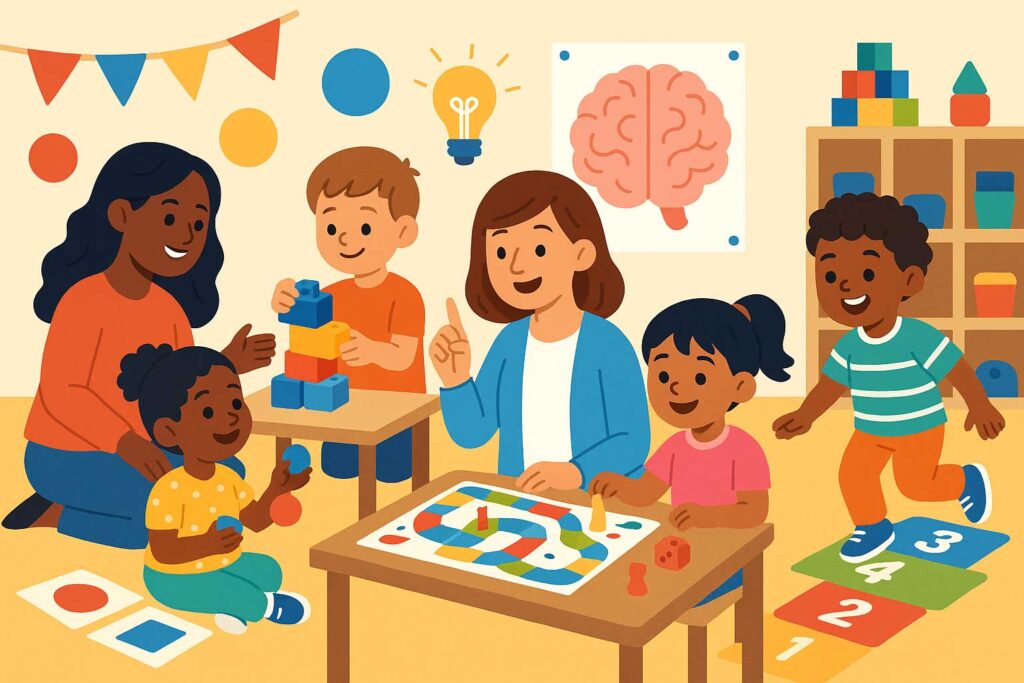
Play and Playful Learning: Perhaps the most powerful natural context for executive function cultivation is play. During play, children practice all dimensions of executive functioning: holding rules in mind (working memory), inhibiting inappropriate responses (inhibitory control), and shifting strategies when circumstances change (cognitive flexibility). Games requiring turn-taking, rule-following, and strategic thinking provide ideal practice opportunities. Imaginative play particularly supports cognitive flexibility as children adopt different roles and perspectives[web:105][web:108][web:114].
Research demonstrates that children with greater access to free, unstructured play develop stronger executive function skills than peers with limited play opportunities. This finding has important implications in an era where structured academics increasingly encroach on childhood play—the very activity that optimally develops the capabilities supposedly advanced through academics[web:108].
Physical Activity and Sports: Physical engagement—whether through sports, movement games, yoga, or martial arts—provides unique benefits for executive function development. These activities require sustained attention, impulse control (waiting for turns, following rules), and flexible adaptation to changing circumstances. Additionally, physical activity enhances overall brain development and neuroplasticity. Children engaging regularly in organized sports demonstrate improved academic performance and behavioral regulation[web:105][web:111].
Structured Goal-Setting and Progress Monitoring: Encouraging children to establish goals, take action toward them, and monitor progress builds executive functions including planning, persistence, and metacognitive awareness. This practice transforms executive functioning from abstract psychological construct to concrete, personally relevant skill.
Risk Factors and Vulnerabilities in Executive Function Development
Certain factors place children at heightened risk for compromised executive function development:
Early Adversity and Trauma: Children experiencing abuse, neglect, domestic violence, or extreme poverty show delayed executive function development compared to peers. The stress response system becomes hyperactive, elevating cortisol and other stress chemicals that impair prefrontal development. These children often display reduced inhibitory control, difficulty sustaining attention, and challenges with cognitive flexibility[web:104][web:109].
Developmental Disorders: Children with ADHD, autism spectrum disorder, and other neurodevelopmental conditions often show atypical executive function development. These children benefit from explicit, intensive support in building executive function skills rather than assuming deficits are fixed.
Limited Enrichment and Practice Opportunities: Children with restricted access to play, limited adult interaction, few problem-solving opportunities, and minimal exposure to complex language and thinking develop executive functions more slowly than peers with enriched experiences.
Part 3: Strategies for Cultivating Executive Functions at Home and School
Game-Based Development of Executive Functions
Games provide natural, engaging contexts for executive function practice. Strategic selection of games targeting specific capabilities accelerates development:
Games Targeting Working Memory:
- Memory and Concentration Games: Matching games, “I Spy,” card games requiring memory of previous plays
- Sequential Games: Games requiring remembering and executing multi-step sequences
- Story Sequencing: Arranging picture cards to create coherent narratives, exercising memory for narrative structure
Games Targeting Inhibitory Control:
- Simon Says: Children must inhibit automatic responses to commands not preceded by “Simon Says”
- Freeze: Children freeze when music stops, practicing impulse control
- Red Light, Green Light: Requires stopping despite momentum, a challenging but developmentally appropriate inhibitory control task
- Waiting Games: Any turn-based game requires inhibiting the urge to take a turn out of sequence
Games Targeting Cognitive Flexibility:
- Games with Changing Rules: Modifying rules mid-game challenges children to adapt quickly
- Role-Playing and Pretend Play: Adopting different characters and perspectives builds flexibility
- Logic Puzzles: Rush Hour, Gravity Maze, and similar spatial reasoning games require flexible thinking
Sports and Movement Activities:
- Soccer, Basketball, Team Sports: Require attention, rule-following, strategic thinking, and emotional regulation
- Obstacle Courses: Children plan sequences, overcome challenges, and demonstrate adaptability
- Yoga and Mindfulness Movement: Support focus, body awareness, and calm regulation
Classroom Strategies for Supporting Executive Function Development
Educational settings provide ideal contexts for systematic executive function cultivation. Effective approaches include:
Explicit Instruction in Executive Function Strategies: Rather than assuming children automatically develop these skills, directly teach them. Instruction might include: teaching specific attention strategies (“When you feel your mind wandering, look at the speaker”), modeling planning processes (“Let’s think about what we need to do, in what order”), and providing frameworks for regulating emotions.
Environmental Design Supporting Executive Functions: Classroom organization directly impacts executive functioning. Clear visual schedules support working memory for daily sequences. Organized spaces with labeled storage support organization and planning. Quiet focus areas enable concentration. Visual timers help children manage time awareness.
Structured Transitions and Clear Expectations: Children with underdeveloped executive functions struggle with transitions between activities. Explicit preparation for transitions, visual cues signaling changes, and consistent routines reduce transition friction and support working memory and cognitive flexibility.
Opportunities for Choice and Self-Direction: Allowing children meaningful choices within structured parameters—which activity to do first, which partner to work with, which problem-solving approach to attempt—builds executive function muscles. Children develop planning, decision-making, and persistence.
Regular Reflection and Goal-Setting: Structured reflection on effort, strategy, and progress builds metacognitive awareness—thinking about thinking—a sophisticated executive function. Goal-setting with progress monitoring provides motivation and builds persistence.
Family-Based Executive Function Support
Parents and caregivers wield tremendous influence on executive function development:
Organizing Family Routines: Predictable routines—regular mealtimes, consistent bedtimes, expected homework times—support children’s ability to organize themselves. Gradually reducing adult scaffolding enables children to manage routines increasingly independently, building executive functions.
Coaching Rather Than Controlling: Rather than simply telling children what to do, parents can coach them through decision-making: “What do you need to do next? How will you remember? What’s your plan?” This coaching builds executive function capacity far more effectively than simple compliance.
Managing Screen Time Strategically: Excessive screen time, particularly passive consumption of content, offers little opportunity for executive function practice. Interactive, game-based screen experiences offer more benefit than passive viewing. Offline play remains superior for executive function development.
Modeling and Discussion of Executive Function Strategies: Parents who externalize their own thinking—”I’m feeling frustrated, so I’m going to take a break before responding”—provide templates that children internalize. Discussing how to handle challenges, remember complex information, and manage emotions explicitly builds children’s strategy repertoire.
Part 4: Assessment and Supporting Children with Executive Function Challenges
Recognizing Executive Function Challenges
Children with weak executive functions often display:
- Inattention and Distractibility: Difficulty maintaining focus despite trying; easily distracted by environmental stimuli
- Impulse Control Problems: Acting without thinking; interrupting; difficulty waiting turns; emotional outbursts
- Organization and Planning Difficulties: Struggling to break tasks into steps; difficulty starting projects; procrastination
- Emotional Dysregulation: Intense reactions disproportionate to situations; difficulty recovering from frustration or disappointment
- Resistance to Change: Difficulty transitioning between activities; distress when routines change
- Poor Working Memory: Forgetting instructions; difficulty following multi-step sequences; appearing “not to listen”
Supporting Children with Executive Function Challenges
Children struggling with executive functions benefit from:
External Supports and Scaffolding: Reducing cognitive load through external supports—written checklists instead of relying on memory, timers providing temporal structure, visual schedules—enables children to function more successfully while their internal executive function capacity develops.
Individualized Strategy Instruction: Teaching specific strategies matched to particular challenges—color-coding materials for organization, using self-talk scripts for impulse control, teaching systematic problem-solving approaches—provides concrete tools.
Increased Practice Opportunities: Children with weak executive functions benefit from more, not less, practice through games and activities. Intensive, enjoyable practice over extended periods builds capability.
Medication and Professional Support: For some children, particularly those with ADHD, medication combined with behavioral strategies and executive function coaching supports development. Professional support from occupational therapists, educational psychologists, or developmental specialists can accelerate growth.
Part 5: Executive Functions and Long-Term Success
Beyond Academic Achievement: Life Success and Well-being
While executive functions strongly predict academic outcomes, their influence extends far beyond school:
Workplace Success: In employment contexts, abilities to plan complex projects, maintain focus despite distractions, adapt to changing circumstances, and regulate emotions—all executive functions—predict job performance and career advancement.
Relationship Quality: The emotional regulation and cognitive flexibility that support strong executive functions enable healthier relationships, more effective communication, and greater ability to navigate interpersonal challenges.
Physical Health: Executive function abilities relate to health behaviors—managing medication schedules, maintaining exercise routines, resisting impulsive unhealthy choices—contributing to better long-term physical health.
Mental Health and Resilience: The ability to regulate emotions, maintain perspective, and persist through challenges—core executive function capabilities—builds resilience and reduces vulnerability to anxiety and depression.
Developmental Continuity: Building Through Life Stages
Executive function development continues throughout life, but early investment yields maximum benefit. The plasticity of childhood brains means that experiences in early years have outsized influence. Yet adults retain capacity to develop these skills, suggesting that investment in executive function support benefits individuals at all ages.
Part 6: Practical Implementation Guide
Starting Where You Are: Creating Your Executive Function Development Plan
Whether you’re an educator, parent, or learning professional, you can begin supporting executive function development immediately:
Assessment: Observe or assess current executive function capabilities using informal observation, standardized assessments, or by noting areas of difficulty in daily functioning.
Priority Identification: Determine which executive function components most need development—is this about working memory, inhibitory control, cognitive flexibility, or broader capabilities?
Strategy Selection: Choose activities, games, and strategies matching your context and the child’s age and interests.
Consistent Implementation: Build practice into regular routines—daily if possible. Consistency matters more than duration.
Progress Monitoring: Notice and celebrate improvements, however small. Adjust strategies based on response.
Patience and Persistence: Executive function development is gradual. Brain changes take time. Celebrate effort and progress rather than expecting immediate transformation.
Conclusion: The Investment That Keeps Giving
The investment in cultivating executive functions in childhood pays dividends across the entire lifespan. Children who develop strong working memory, inhibitory control, and cognitive flexibility experience academic success, navigate social relationships more effectively, regulate emotions more skillfully, and develop greater resilience in facing life’s inevitable challenges.
As an educator, parent, or learning professional, supporting executive function development represents one of the highest-impact interventions you can provide. Through intentional game-based practice, environmental support, skillful coaching, and consistent reinforcement, you can systematically build the brain’s control tower—the capabilities underlying everything else children accomplish.
The time to begin is now. Start small. Choose one activity. Implement consistently. Notice improvements. Expand gradually. The compounding benefits over months and years will astound you. You’re not merely teaching academic content or behavioral compliance; you’re literally building the neural architecture supporting lifelong success and well-being.