
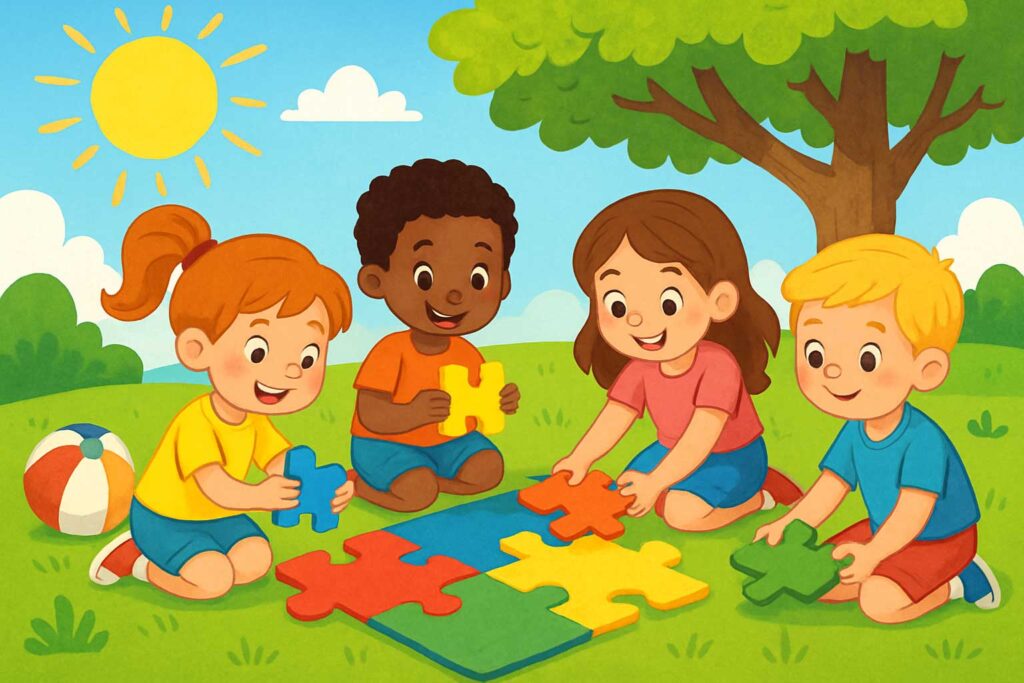
Summer vacation offers a perfect opportunity to take learning outdoors while keeping children’s minds active and engaged. Outdoor puzzle activities combine the cognitive benefits of problem-solving with the physical advantages of being in nature, creating a holistic approach to summer learning. This article explores creative ways to incorporate puzzles into outdoor summer activities, helping children develop critical thinking skills while enjoying the sunshine and fresh air.
The Benefits of Outdoor Puzzle Play
Before diving into specific activities, it’s worth understanding why outdoor puzzle play is particularly valuable during summer months:
Cognitive Development in Natural Settings
Research shows that learning in natural environments can enhance cognitive function in several ways:
•Improved attention: Natural settings reduce mental fatigue and increase concentration
•Enhanced creativity: Exposure to nature stimulates creative thinking and problem-solving
•Better retention: Multi-sensory outdoor experiences create stronger memory connections
•Reduced stress: Natural environments lower cortisol levels, creating optimal conditions for learning
Physical and Mental Health Balance
Outdoor puzzle activities provide a perfect balance between:
•Physical activity and movement
•Mental challenges and problem-solving
•Social interaction (for group activities)
•Connection with nature
Preventing Summer Learning Loss
Engaging in cognitively stimulating activities during summer helps prevent the “summer slide” – the loss of academic skills that often occurs during extended breaks from school. Puzzles specifically target:
•Logical reasoning
•Pattern recognition
•Spatial awareness
•Working memory
•Strategic thinking
Outdoor Puzzle Scavenger Hunts
Scavenger hunts combine physical exploration with puzzle-solving for an engaging outdoor activity.
Basic Puzzle Hunt
Create a series of clues, each leading to the next location:
1.Start with a simple puzzle (age-appropriate word scramble, riddle, or math problem)
2.Solution reveals the next location (e.g., “Look under the big oak tree”)
3.At each location, hide another puzzle and clue
4.Final location contains a special prize or activity
Materials needed: Paper, pen, small containers, prizes
Educational focus: Problem-solving, following directions, logical thinking
Photo Puzzle Hunt
This modern twist uses photography as part of the puzzle:
1.Take close-up photos of distinctive objects around your yard, neighborhood park, or beach
2.Print the photos and number them
3.Challenge children to find each location based on the photo details
4.At each location, they collect a puzzle piece or clue
5.After finding all locations, they assemble the collected pieces to complete a final puzzle
Materials needed: Camera/smartphone, printer, puzzle pieces or clues
Educational focus: Visual discrimination, attention to detail, part-whole relationships
Coordinate Grid Treasure Hunt
This activity introduces basic mapping and coordinate skills:
1.Create a simple grid map of your outdoor space
2.Mark coordinates (A1, B2, etc.) on the grid
3.Provide a list of coordinates where “treasure” is hidden
4.At each location, hide a puzzle piece, math problem, or word clue
5.Solve the final puzzle by combining all found elements
Materials needed: Grid paper, markers, small treasures or puzzle pieces
Educational focus: Spatial awareness, coordinate geometry, mapping skills
Natural Materials Puzzle Activities
Using materials found in nature creates sustainable, cost-free puzzle opportunities.
Rock Balancing Puzzles
This mindfulness activity challenges spatial reasoning:
1.Collect rocks of various sizes and shapes
2.Challenge children to create the tallest or most interesting balanced structure
3.Introduce constraints like “must use at least 7 rocks” or “must have a bridge-like element”
4.Document creations with photos before disassembling
Materials needed: Rocks of various sizes (found in nature)
Educational focus: Physics concepts, spatial reasoning, patience, trial and error
Natural Pattern Completion
This activity strengthens pattern recognition:
1.Create the beginning of a pattern using natural materials (leaves, stones, sticks, flowers)
2.Ask children to identify the pattern and continue it
3.Increase complexity by introducing multiple variables (size, color, type, orientation)
4.Challenge them to create their own patterns for others to complete
Materials needed: Collected natural materials
Educational focus: Pattern recognition, logical reasoning, classification skills
Nature Mandalas and Puzzles
This artistic activity develops symmetry awareness:
1.Find a flat, clear space outdoors
2.Begin by placing items in a circular pattern around a center point
3.Challenge children to continue the pattern, maintaining symmetry
4.For younger children, draw a template with chalk or string to guide placement
5.For older children, create more complex geometric requirements
Materials needed: Collected natural items (petals, leaves, stones, etc.)
Educational focus: Symmetry, geometric patterns, artistic expression, attention to detail
Water-Based Summer Puzzles
Water activities are perfect for hot summer days while still providing cognitive challenges.
Floating Puzzle Challenge
This activity combines science concepts with puzzle-solving:
1.Create puzzle pieces from waterproof materials (foam sheets work well)
2.Number or color-code the backs of pieces to create sets
3.Float the pieces in a kiddie pool, water table, or even bathtub
4.Challenge children to collect and assemble the floating puzzles
5.Add complexity by using a timer or tools like nets with handles of different lengths
Materials needed: Foam sheets, waterproof markers, scissors, water container
Educational focus: Hand-eye coordination, spatial relationships, problem-solving under constraints
Water Measurement Puzzles
This activity introduces mathematical concepts through water play:
1.Provide various containers of different sizes and shapes
2.Pose challenges like “Fill the tall container using only the small cup” or “Make these two containers have equal amounts of water”
3.Create a sequence of containers that must be filled in a specific order with specific amounts
4.For older children, introduce actual measurement units and more precise challenges
Materials needed: Various containers, water source, measuring cups (optional)
Educational focus: Volume concepts, estimation, mathematical thinking, scientific method
Ice Excavation Puzzles
Perfect for the hottest days, this activity combines science with discovery:
1.Freeze small puzzle pieces or objects in ice blocks or cubes
2.Challenge children to extract the items and solve the puzzle
3.Provide various tools (spray bottles with warm water, salt, small hammers, etc.)
4.Discuss which methods work best and why (introducing basic science concepts)
5.Once all pieces are retrieved, complete the puzzle or classify the objects
Materials needed: Ice cube trays or containers, small objects or puzzle pieces, freezer, excavation tools
Educational focus: Scientific principles, problem-solving, patience, fine motor skills
Large-Scale Outdoor Puzzles
These activities create immersive puzzle experiences that involve the whole body.
Lawn Grid Puzzles
Transform your lawn into a life-sized puzzle board:
1.Create a grid on grass using chalk spray, string, or hula hoops
2.Design puzzles where children move within the grid following specific rules
3.Examples include:
•Human chess or checkers
•Life-sized Sudoku with numbered cards
•Pattern completion with colored paper plates
•Coordinate movement games (“Move to C3, then two spaces north”)
Materials needed: Grid markers (chalk, string, hula hoops), game pieces
Educational focus: Spatial awareness, strategic thinking, rule following, gross motor skills
Shadow Shape Puzzles
This activity uses the sun’s position to create time-sensitive puzzles:
1.Place objects on a large piece of paper or cardboard in the sun
2.Trace the shadows they cast, then remove the objects
3.Challenge children to match objects to their shadows by placing them correctly
4.Return later in the day to observe how the shadows have changed
5.Discuss why the shadows moved and changed shape (introducing astronomy concepts)
Materials needed: Various objects, large paper, sunny day, markers
Educational focus: Light and shadow concepts, spatial reasoning, scientific observation
Human Knot Puzzle
This collaborative problem-solving activity builds teamwork:
1.Form a circle with 5-10 participants
2.Everyone reaches across and grabs hands with two different people
3.Without letting go, the group must untangle themselves into a circle
4.Variations include:
•Adding verbal constraints (no talking)
•Blindfolding some participants
•Setting time limits
Materials needed: None (just people)
Educational focus: Spatial problem-solving, communication, teamwork, body awareness
DIY Outdoor Puzzle Creation
Creating puzzles is often as educational as solving them. These activities let children design their own outdoor puzzles.
Sidewalk Chalk Maze Design
This activity turns driveways and sidewalks into puzzle canvases:
1.Challenge children to design a maze using sidewalk chalk
2.Establish rules like “must have at least three dead ends” or “must include one shortcut”
3.Add puzzle elements within the maze (math problems to solve, riddles, etc.)
4.Invite others to solve the maze
5.For added fun, use water spray bottles to erase paths and create a disappearing maze
Materials needed: Sidewalk chalk, measuring tools (optional), spray bottles (optional)
Educational focus: Spatial planning, design thinking, problem creation (vs. just solving)
Natural Materials Puzzle Creation
This activity encourages children to become puzzle designers:
1.Collect natural materials like flat stones, sticks, leaves, etc.
2.Create puzzle designs on a flat surface
3.Document the completed design with a photo
4.Mix up the pieces and challenge someone else to recreate the design
5.Variations include:
•Memory challenges (show the design briefly, then hide it)
•Collaborative building (each person adds one piece following a pattern)
•3D construction challenges
Materials needed: Collected natural materials, camera (optional)
Educational focus: Creativity, spatial design, pattern creation, instruction giving
Secret Code Trails
This activity combines physical movement with code-breaking:
1.Create a simple substitution code (symbols for letters or numbers)
2.Leave coded messages along a trail in your yard or a park
3.Each solved message provides directions to the next clue
4.Final message leads to a special location or reward
5.For older children, increase code complexity or add mathematical elements
Materials needed: Paper, writing tools, containers to protect clues outdoors
Educational focus: Symbolic thinking, pattern recognition, persistence, logical reasoning
Adapting Commercial Puzzles for Outdoor Use
Many indoor puzzles can be modified for outdoor summer play.
Weather-Proofing Puzzle Games
Transform favorite puzzles for outdoor durability:
1.Laminate paper puzzles or coat with clear contact paper
2.Transfer board games to outdoor versions using:
•Shower curtains as game boards
•Beach rocks as playing pieces
•Plastic containers for storage
3.Create giant versions of small puzzles using:
•Foam sheets for puzzle pieces
•Plywood for sturdier games
•Vinyl tablecloths for flexible game surfaces
Materials needed: Laminator or contact paper, original puzzles, outdoor-friendly materials
Educational focus: Same benefits as original puzzles, plus creative adaptation skills
Beach-Friendly Puzzle Kits
Create portable puzzle collections for beach days:
1.Select puzzles that won’t blow away (magnetic options work well)
2.Store in waterproof containers with secure lids
3.Include brushes for removing sand
4.Add beach-themed challenges like:
•Shell sorting and pattern creation
•Sand castle design challenges with specific requirements
•Beach treasure hunt with photo clues
Materials needed: Waterproof containers, beach-friendly puzzle materials
Educational focus: Various cognitive skills, adaptation to outdoor environment
Glow-in-the-Dark Night Puzzles
Extend puzzle play into summer evenings:
1.Apply glow-in-the-dark paint to puzzle pieces
2.Hide pieces around the yard after dark
3.Provide flashlights for searching
4.Create constellation puzzles by placing glow dots in star patterns
5.Challenge children to connect the dots in specific ways
Materials needed: Glow-in-the-dark paint or stickers, flashlights, puzzles
Educational focus: Visual discrimination in low light, astronomy connections, spatial memory
Conclusion
Summer outdoor puzzle activities offer a perfect blend of physical activity, cognitive challenge, and connection with nature. By taking puzzles beyond the coffee table and into the sunshine, parents and educators can help children maintain academic skills while creating joyful summer memories.
The activities described in this article support multiple developmental areas simultaneously, from mathematical thinking and scientific concepts to creativity and social skills. Best of all, they transform “brain work” into play, helping children develop positive associations with learning and problem-solving.